
What Is a Carbon Allotrope?
An allotrope is one of two or more different structural forms a single chemical element can take. The atoms are identical — what changes is how they are bonded and arranged — and that arrangement alone can transform a material's hardness, colour, conductivity and behaviour. No element shows this off more dramatically than carbon.
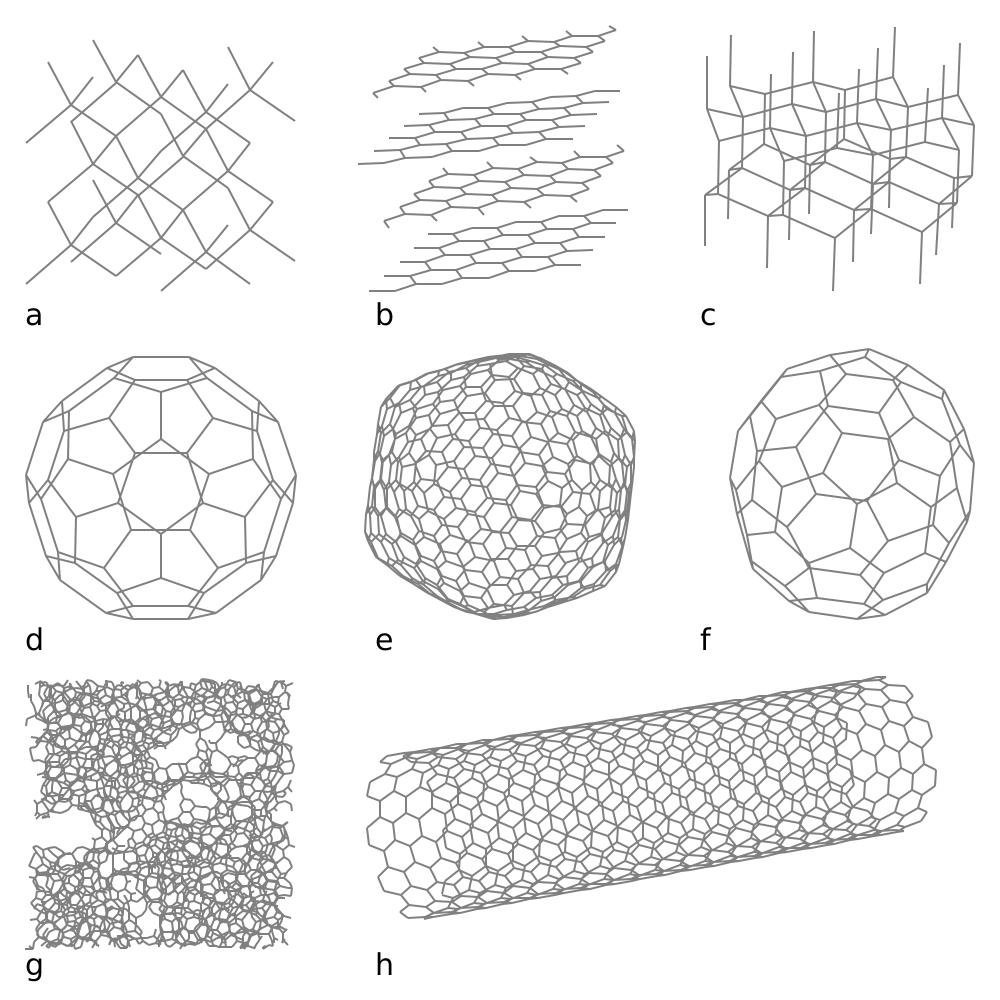
Same atoms, opposite materials
The classic illustration is the difference between diamond and graphite — both 100% carbon, yet about as different as two materials can be:
- Diamond — each atom bonds to four others in a rigid three-dimensional lattice. The result is the hardest natural material known, transparent, and an electrical insulator.
- Graphite — atoms bond into flat sheets that stack loosely and slide over one another. The result is soft, grey, slippery, and electrically conductive — it is the "lead" in a pencil.
Nothing was added or removed to turn one into the other. Only the geometry changed — and with it, everything.
The carbon family
Carbon's known allotropes include:
- Diamond and lonsdaleite — rigid 3-D lattices.
- Graphite — stacked flat sheets.
- Graphene — a single one-atom-thick sheet of graphite, isolated in 2004 (a feat that earned its own Nobel Prize in 2010).
- Carbon nanotubes — graphene sheets rolled into tubes.
- Fullerenes such as C60, C70 and C540 — atoms closed into hollow cages and spheres.
- Amorphous carbon — carbon with no long-range order, such as soot and charcoal.
Where C60 fits
C60 (buckminsterfullerene) is the spherical, molecular member of the carbon family — 60 atoms closed into a hollow soccer-ball cage. It was discovered in 1985 and recognised with the 1996 Nobel Prize in Chemistry, and its shape is a nod to Buckminster Fuller's geodesic domes. Same element as the diamond on a ring and the graphite in a pencil — a completely different shape, and a completely different set of properties.
Why it matters here
Understanding that C60 is a distinct, well-defined carbon allotrope is the starting point for reading the science honestly. It is a specific molecule with a specific structure — not a vague "carbon supplement" — and that is exactly why it can be studied, measured, and lab-tested for purity. For the published research on C60 itself, see our research summaries.
Educational information only. Sources: American Chemical Society; Encyclopaedia Britannica — allotropy. Diagram: "Andel," Wikimedia Commons, CC BY-SA 4.0.