The Discovery of C60 & the 1996 Nobel Prize
The 1996 Nobel Prize in Chemistry was awarded jointly to Robert F. Curl Jr., Sir Harold W. Kroto and Richard E. Smalley "for their discovery of fullerenes." What began as a question about the chemistry of distant stars ended up opening an entirely new branch of science — and giving the molecule at the heart of everything we make its name.
Eleven days in 1985
Harold Kroto, a chemist at the University of Sussex, was fascinated by long chains of carbon that form in the atmospheres of aging stars. To recreate those conditions he travelled to Rice University in Houston, where Richard Smalley had built a remarkable machine that could vaporise almost any material with a laser and study the clusters that formed. Together with Robert Curl and their graduate students — James Heath, Yuan Liu and Sean O'Brien — the team turned that laser onto graphite over about eleven days in September 1985.
Among the carbon clusters, one kept appearing far more often than any other: a cluster of exactly 60 carbon atoms, strikingly stable. Working out why led them to a startling conclusion — the atoms had closed into a hollow cage of 12 pentagons and 20 hexagons, the exact geometry of a soccer ball and of Buckminster Fuller's geodesic domes. They named it buckminsterfullerene.
The three who shared the Prize
Sir Harold W. Kroto (1939–2016)
The British chemist whose curiosity about interstellar carbon set the whole experiment in motion. Kroto spent most of his career at the University of Sussex and was knighted in 1996, the same year as the Nobel. Beyond the lab he was a tireless champion of science education, devoting his later years to making science accessible to the public and to students around the world.
Richard E. Smalley (1943–2005)
The Rice University chemist whose laser-vaporisation apparatus made the discovery possible. Smalley went on to become one of the founding figures of nanotechnology — his later work on carbon nanotubes helped launch the field of nanoscience. He continued researching and advocating for nanotech's promise until his death from leukaemia in 2005; the research institute he founded at Rice now bears his name.
Robert F. Curl Jr. (1933–2022)
The Texas-born chemist who joined Rice in 1958 and served there for half a century, retiring as professor emeritus in 2008. A meticulous spectroscopist admired for his rigour and generosity as a colleague and mentor, Curl provided much of the careful analysis that turned a surprising result into a confirmed discovery.
A discovery that keeps giving
The "carbon cages" the trio found opened a whole new field. Their work directly sparked nanoscience and led, in the years that followed, to carbon nanotubes and to graphene — materials now central to electronics, medicine and materials science. C60 itself became the first widely studied member of the carbon allotrope family's molecular branch, and remains the foundation of the oils we make.
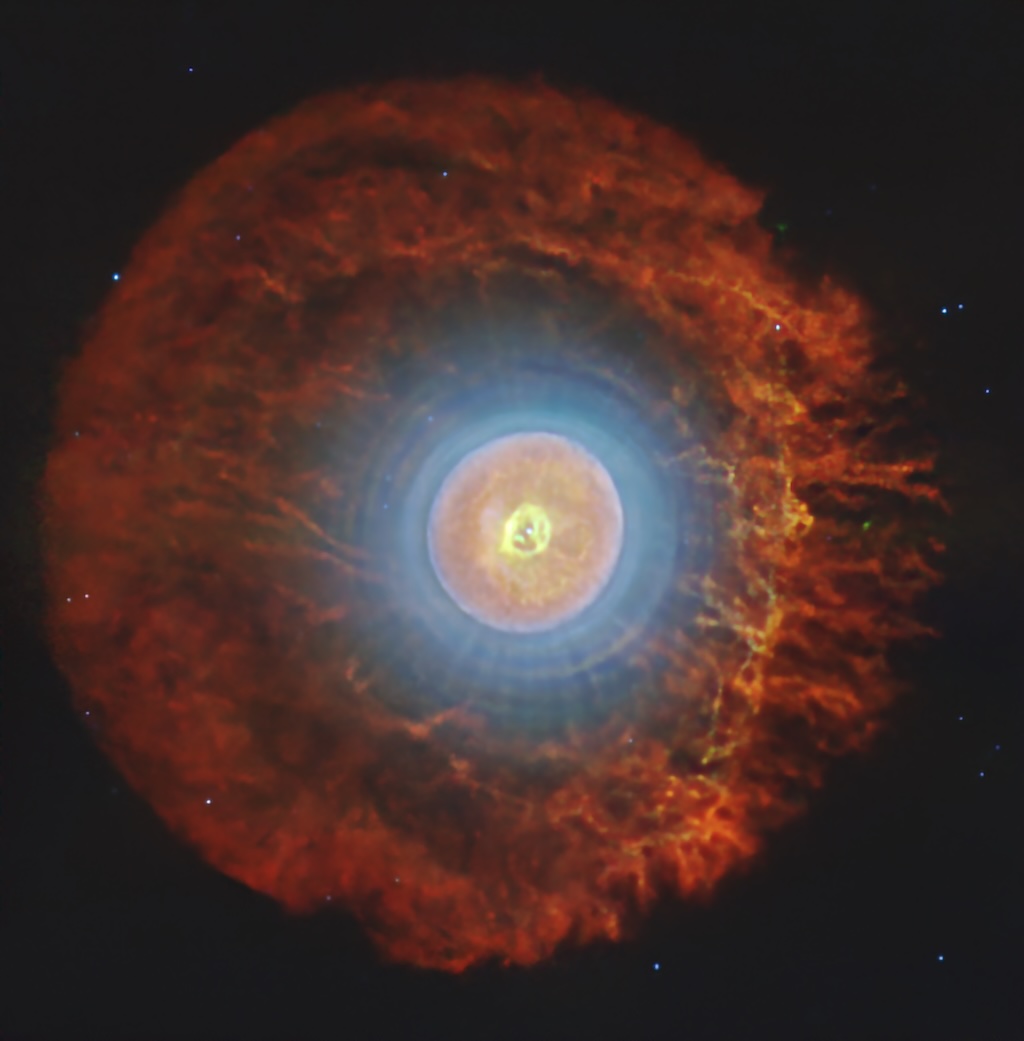
Sources: NobelPrize.org — 1996 press release; American Chemical Society; Science History Institute; Britannica. Nebula image: NASA (public domain).